Orbital mechanics
Orbits, propulsion, gravity, distances: five ideas from spaceflight, explained then calculated in your browser.
Five workstations, five scales: from Earth orbital insertion to distances between galaxies. Each station explains a concept, then lets you play with it yourself.
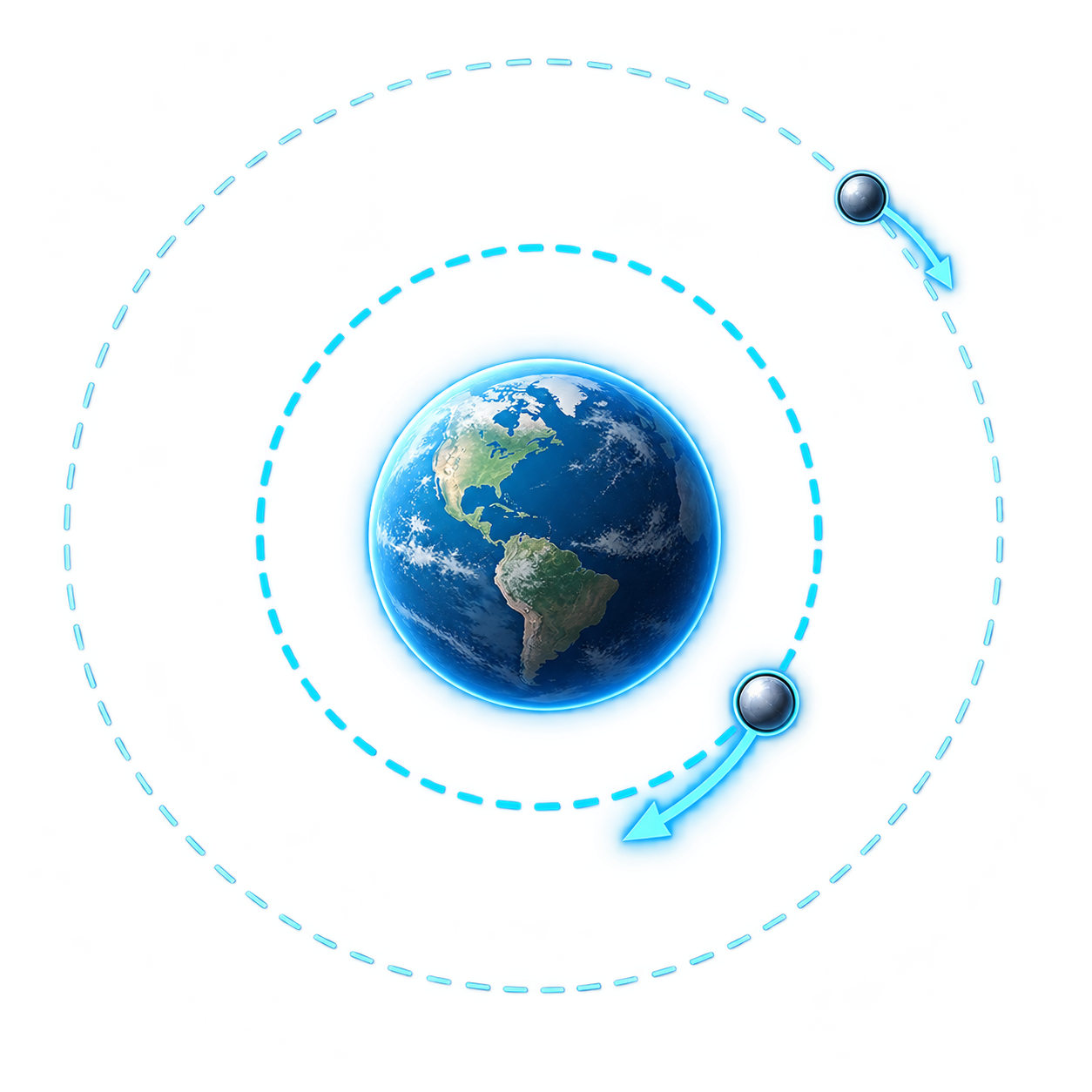
Falling without ever hitting the ground
Being in orbit doesn't mean escaping gravity. An orbiting object is constantly falling toward the body it circles, but has enough horizontal speed that the ground curves away beneath it at the same rate. So it falls without ever touching down. That's exactly what the ISS experiences: at about 400 km altitude, it travels at 7.7 km/s (about 28,000 km/h) and completes a full orbit in 90 minutes.
Counterintuitive: the farther out you go, the slower you need to travel to stay in orbit. A geostationary satellite, at 35,786 km altitude, only travels at 3.07 km/s — much slower than the ISS — but takes exactly one sidereal day to complete an orbit, which makes it appear stationary above a point on the equator. This trade-off is what distinguishes low orbit — fast and energy-efficient — from geostationary orbit — slower but far more costly to reach.
Going further — the Moon obeys the same principle, just on a much larger scale: it falls toward Earth from 384,000 km away, moving forward just enough to keep missing it.
Simulate an orbital insertion
To get a sense of scale
Reference orbits
| Orbit | Altitude | Speed | Period |
|---|
A currency unlike any other
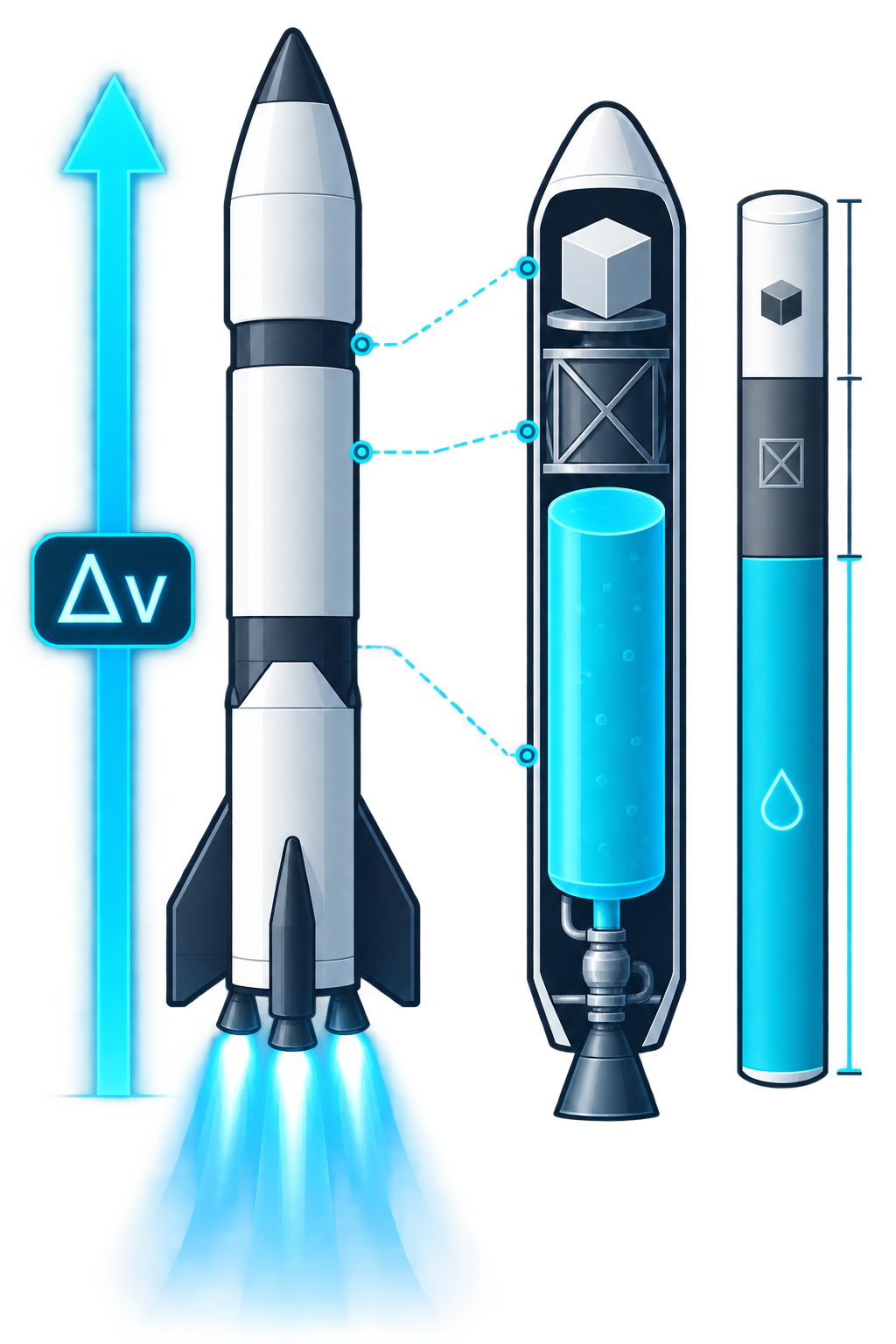
Delta-v (Δv) is the total change in velocity a vehicle must produce to carry out a manoeuvre — reaching an orbit, changing inclination, heading to Mars, braking on arrival. These requirements are added together to get the full energy bill of a mission. Its value is fundamental: it lets you compare very different missions independently of vehicle size.
Delta-v budget for some common manoeuvres
| Manoeuvre | Indicative delta-v |
|---|---|
| Earth → low orbit (LEO) | ≈ 9.4 km/s |
| LEO → geostationary transfer orbit | ≈ 2.4 km/s |
| Transfer → geostationary orbit | ≈ 1.5 km/s |
| LEO → trans-lunar injection | ≈ 3.1 km/s |
| Lunar orbit insertion | ≈ 0.9 km/s |
| Lunar landing (from low orbit) | ≈ 1.9 km/s |
| LEO → transfer to Mars | ≈ 3.6 km/s |
| Mars orbit insertion (propulsive) | ≈ 2.1 km/s |
Indicative order-of-magnitude values — the actual budget depends heavily on the chosen trajectory and launch window.
Why are rockets mostly fuel?
The logarithm is the trap: to get more delta-v, it's not enough to add fuel proportionally — every extra kilo of fuel must itself be accelerated, which forces you to carry even more. A rocket isn't a truck carrying its own fuel: for much of the trip, it's carrying a tank whose job is to carry the tank.
Tsiolkovsky rocket equation calculator
And conversely: how much fuel for a target delta-v?
Three propulsion philosophies
| Type | Typical thrust | Typical Isp | Example |
|---|---|---|---|
| Chemical | Hundreds to millions of N | ≈ 300-450 s | Current launch vehicles |
| Ion | mN to a few N | ≈ 2000-3500 s | Deep Space 1 (≈3100 s) |
| Nuclear-thermal | Tens to hundreds of kN (theoretical) | ≈ 850-1100 s | NERVA/Rover (never flew) |
Going further — an ion engine seems unable to push a car, but in the vacuum of space, a tiny thrust applied for months can produce considerable delta-v.
Two words that don't mean the same thing
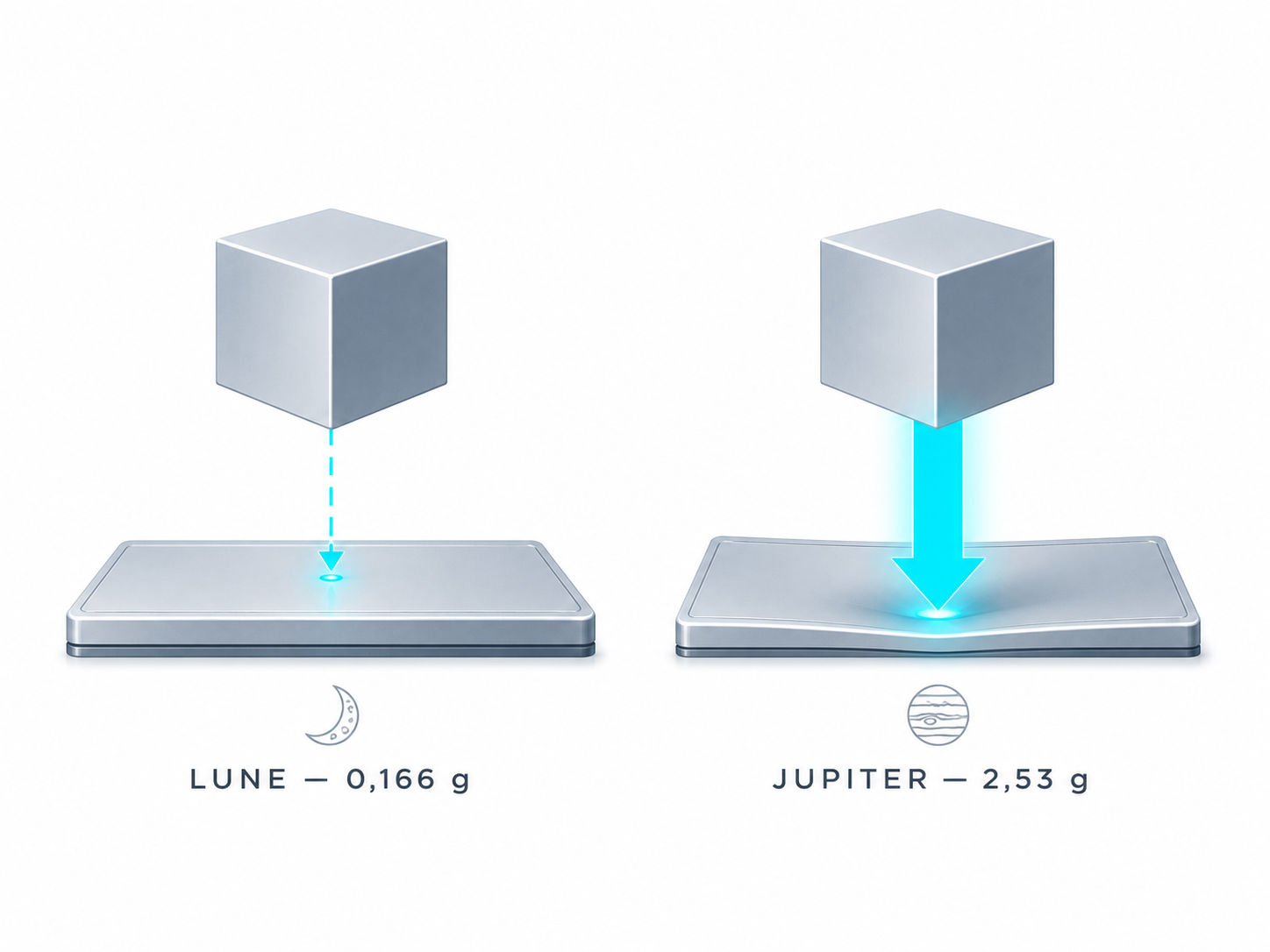
Mass measures how much matter an object contains: it never changes, wherever you are. Weight is a force, which depends on mass and local gravity.
A 70 kg object stays 70 kg on Earth, on the Moon or on Jupiter. Its weight, however, changes completely: about 687 N on Earth (g ≈ 9.81 m/s²), only 113 N on the Moon (g ≈ 1.62 m/s², or 16.5% of Earth weight), and 1,735 N on Jupiter (g ≈ 24.79 m/s² at the 1-bar reference level — Jupiter has no solid surface).
Why do astronauts float?
Not because gravity has disappeared — at the ISS's altitude, it's still almost as strong as on the ground. Astronauts float because the entire station is in permanent free fall around the Earth, like an elevator whose cable just snapped: during the fall, nothing pushes up under your feet anymore. Hence the more accurate term "microgravity" rather than "weightlessness".
Going further — an object doesn't become "light" in space. It becomes hard to keep on the ground because the ground is no longer there to provide the reaction force that creates the sensation of weight.
Your object's weight, elsewhere
Switching units when kilometres become absurd
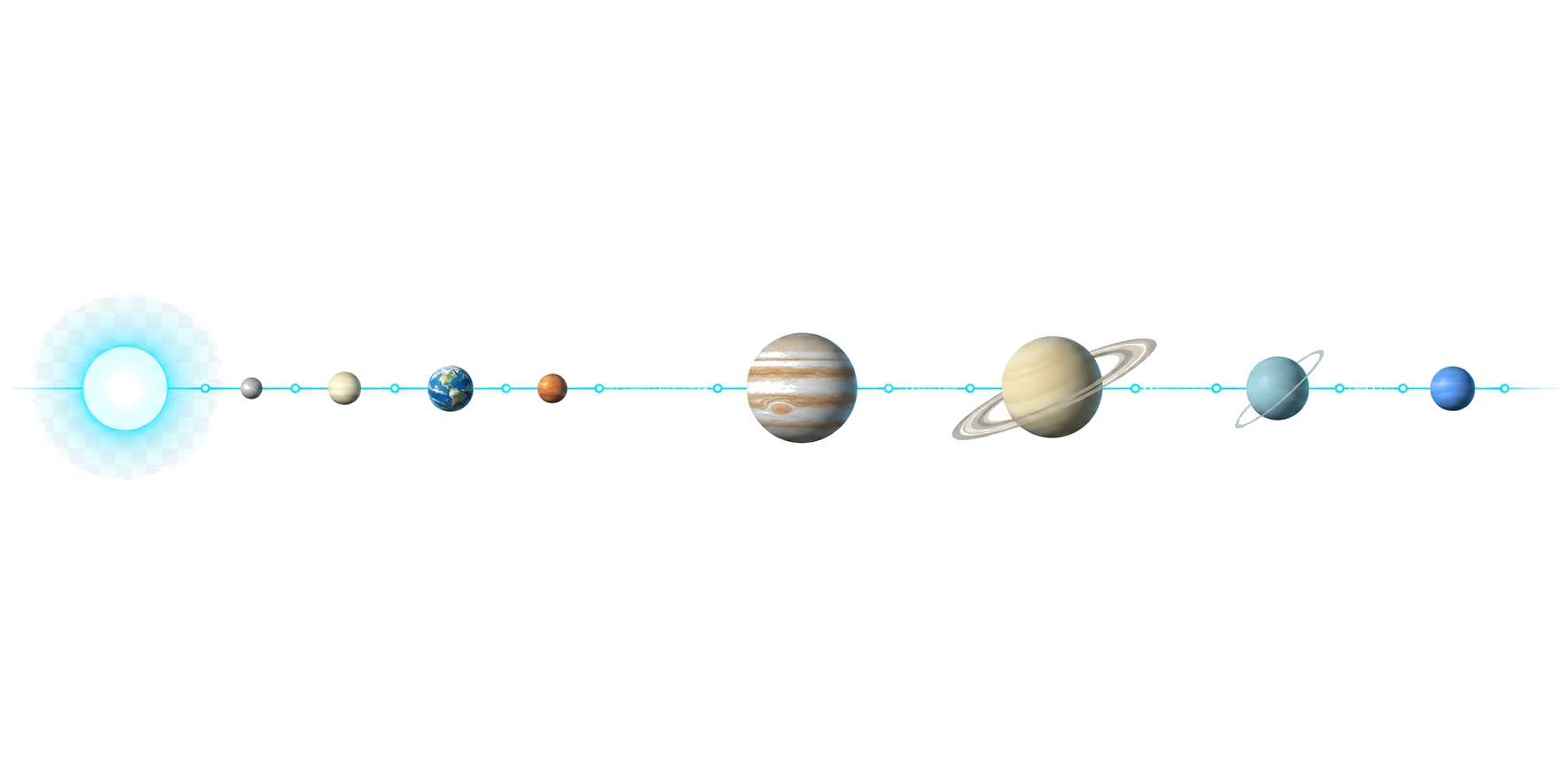
For the solar system, astronomy uses the astronomical unit (AU): the average Earth-Sun distance, exactly 149,597,870.7 km. We also think in light-time — the time light takes, at 299,792 km/s, to cover a distance. One AU corresponds to about 8 minutes 19 seconds of light-time: the sunlight you see left the Sun's surface more than eight minutes ago.
The solar system seen through a clock
| Planet | Average light-time from the Sun |
|---|---|
| Mercury | 3 min 13 s |
| Venus | 6 min 1 s |
| Earth | 8 min 19 s |
| Mars | 12 min 39 s |
| Jupiter | 43 min 16 s |
| Saturn | 1 h 19 min |
| Uranus | 2 h 39 min |
| Neptune | 4 h 0 min |
Earth-Mars, a distance that refuses to sit still
Mars and Earth orbit the Sun at different speeds, so their distance varies enormously — from a few tens to several hundred million kilometres. At the launch of the Mars Odyssey probe, the Earth-Mars distance was about 125 million km, but the trajectory actually flown was about 460 million km: a probe doesn't aim for where Mars is at departure, but where Mars will be on arrival — a bit like throwing a ball to someone who's running.
Going further — the Sun is a strange cosmic clock: you never see it "now", but as it was about 8 minutes 19 seconds ago.
Distance converter
That's: —
When the kilometre stops being useful
Between stars, the kilometre becomes unreadable. We use the light-year — the distance light travels in one year, about 9,460 billion km — and the parsec, about 3.26 light-years (30,900 billion km).
From Proxima to Andromeda
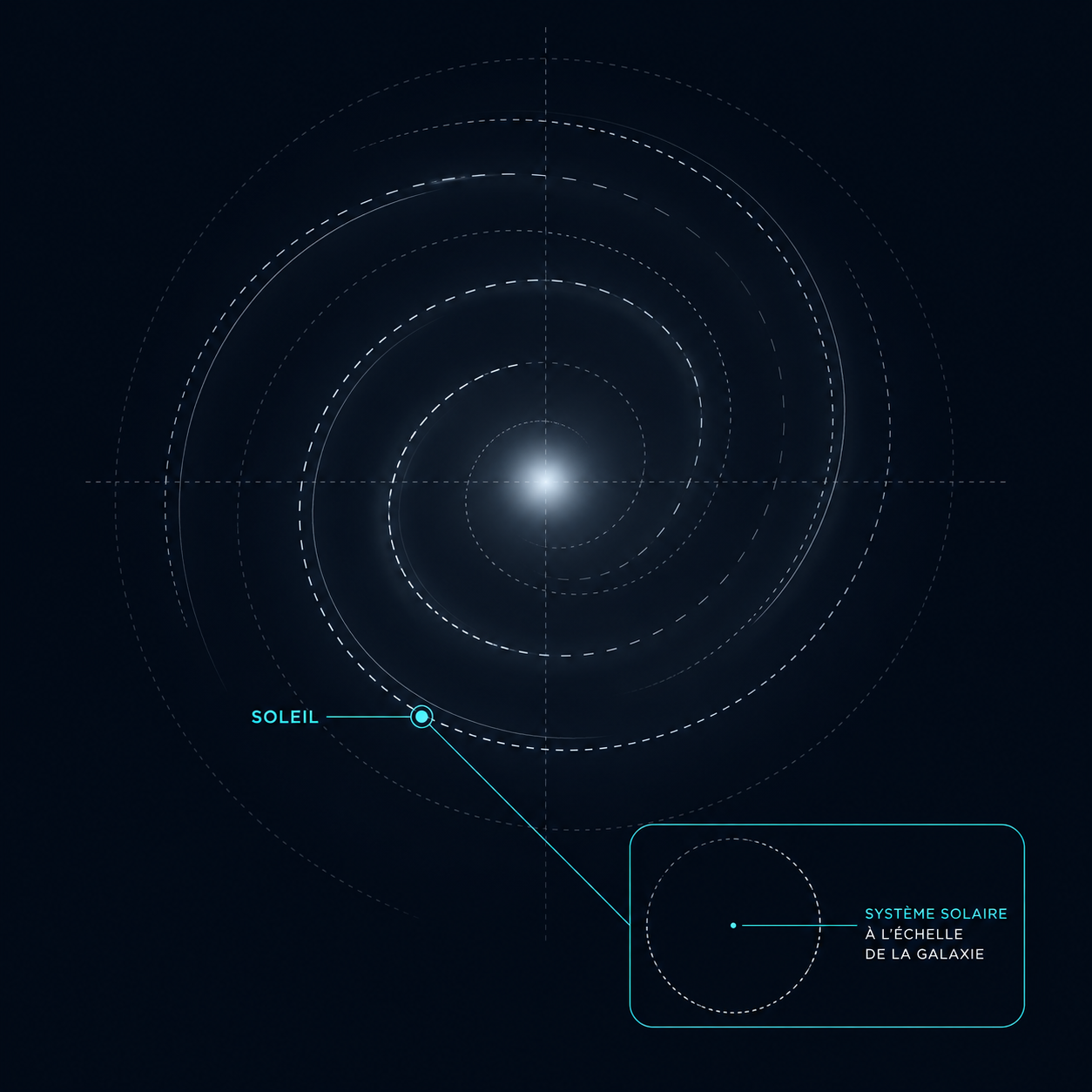
The star closest to the Sun, Proxima Centauri, is 4.25 light-years away: the light we receive from it left the star 4.25 years ago. Our galaxy, the Milky Way, is about 100,000 light-years across and has between 100 and 400 billion stars — even light takes 100,000 years to cross it from edge to edge. Further still, the Andromeda galaxy (M31) is 2.5 million light-years away: what we observe of it today took 2.5 million years to reach us.
| Landmark | Distance |
|---|---|
| Proxima Centauri (nearest star) | ≈ 4.25 light-years |
| Milky Way diameter | ≈ 100,000 light-years |
| Andromeda galaxy (M31) | ≈ 2.5 million light-years |
And where does delta-v fit in?
Going further — Proxima is 4.25 light-years away, the Milky Way is 100,000 light-years across: in the Universe, changing scale doesn't just mean adding zeros, it changes what a distance means.
Galactic distance converter
Content and calculations stay entirely in your browser.